

Medical Device Registration in Australia Process:
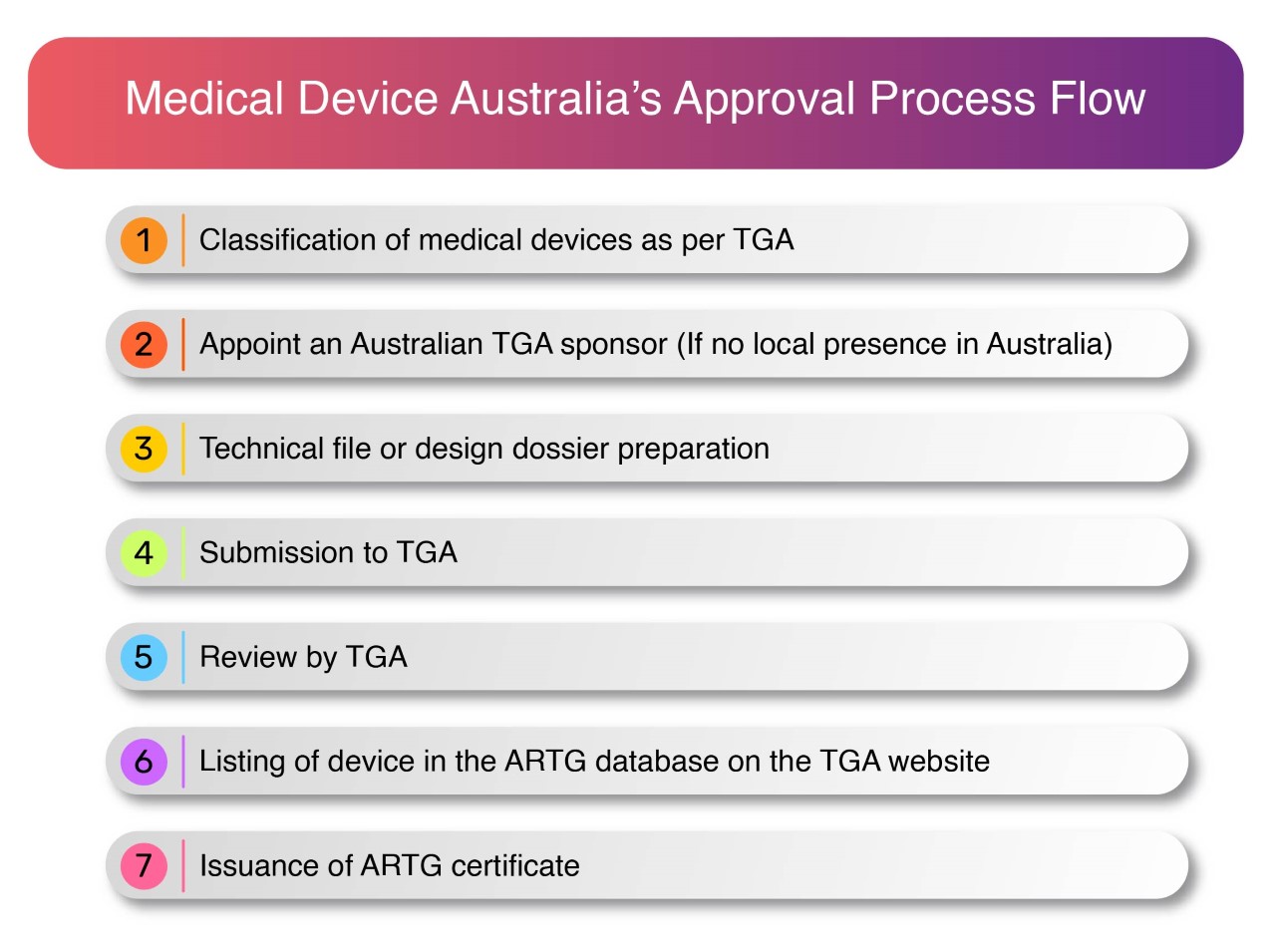
Therapeutic Goods Administration (TGA) oversees regulation of medical devices in Australia through Australian Regulatory Guidelines for Medical Devices (ARGMD) and these guidelines closely resemble with the regulations put into place by the European Union. To gain access to the Australian market, medical device and IVD manufacturers need to include their products in the Australian Register of Therapeutic Goods (ARTG). Medical devices are obliged to be entered in the Australian Register of Therapeutic Goods (ARTG) before they can be lawfully supplied in Australia, imported into Australia or exported from Australia. currently TGA recognises CE marking, means companies who have already acquired the European market can easily meet TGA requirement.
- We help you in the process of making a defined and comprehensive technical file with all product details required forCE Mark Medical Device.
- 188金宝搏网站靠谱吗188金宝慱亚洲体育Company. We’ll also provide assistance in your process of making technical file and review it at every step for compliance, to know more details on this you canContact Us或WhatApps.
Classification of Medical Devices in Australia
In Australia, medical devices are classified as per the Australian Therapeutic Goods (Medical Devices) Regulations 2002. Medical devices are classified with respect to their intended purpose. Particularly, the classification rules take into consideration the degree of invasiveness in the human body, the duration use, location of use, and whether the device relies on a source of energy other than the body or gravity.
Different Device Classes and Associated Risk:
| Class | Risk |
| Class I | Low |
| Class I (supplied sterile) | Low-medium |
| Class I (incorporating a measuring function) | |
| Class IIa | |
| Class IIb | Medium-high |
| Class III | High |
| AIMD (Active Implantable Medical Devices) | High |
Classification of IVD Medical Devices:
基于他们的试管医疗设备进行分类intended purpose and the health risk or personal risk that may arise from an incorrect result.
| Class | Risk |
| Class 1 IVD | No public health risk or low personal risk |
| Class 2 IVD | Low public health risk or moderate personal risk |
| Class 3 IVD | Moderate public health risk or high personal risk |
| Class 4 IVD | High public health risk |
Read More Article–Guide On Medical Device Registration In 9 Different Countries (www.df13ation.com)
Australian TGA Sponsor
Medical device or IVD manufacturers which are not based in Australia are obliged to have in-country representative, called an Australian Sponsor or TGA Sponsor. TGA Sponsor plays vital role in medical device registration in Australia process and post-market compliance by acting as a liaison between the manufacturer and the TGA. Australian TGA Sponsor’s name must appear on device and labelling.
Essential Principles
The manufacturer needs to demonstrate the compliance with the essential principles before applying for inclusion on the Australian Register for Therapeutic Goods (ARTG). These essential principles put forth the fundamental design and manufacturing requirements for medical devices. There are six general essential principles that apply to all devices (relating to health and safety, including long-term safety, with benefits outweighing the risks), and a further nine essential principles about design and construction that apply to devices on a case-by-case basis. Six general essential principles include the following:
- Medical devices should follow the prescribed measures of health and safety.
- Medical devices are needed to design and construct as per the safety norms.
- Medical devices needs to demonstrate their intended purpose
- They need to be Long-term safer.
- Due to transport or storage medical devices should not be adversely affected.
- Benefits of medical devices outweigh any undesirable effects.
Pre-market Assessment: Conformity Assessment of Medical Devices
Conformity assessment is the systematic and ongoing examination of evidences and procedures to determine that the safety of a medical device is acceptable and the device performs as intended and therefore, conforms to the essential principles. Based on device classification, appropriate conformity assessment route must be selected. Devices that have already possess CE certification from European notified bodies have more advantages in meeting TGA requirements. The TGA considers the Medical Device Single Audit Program (MDSAP) audit reports in its conformity assessment, since Australia is one of the partners participating in MDSAP.
Market Authorization: Inclusion of Medical Devices in ARTG
- Inclusion of lower risk devices in the ARTG
For Class I medical devices that do not have a measuring function and are not intended to be supplied sterile, a copy of the manufacturer\’s Declaration of Conformity for the device with the application to include the device in the ARTG must be submitted. Sponsors of these devices must also be able to provide other documentation (e.g., labelling, instruction for use and evidence of the performance of the device, etc) to the TGA on request. - Inclusion of all other devices in the ARTG (Except lower risk)
Any application for inclusion of a medical device in the ARTG must include specific information as required in the application form, including conformity assessment certification from TGA or other comparable overseas regulators and possibly evidence of product assessment. The TGA may approve the inclusion of a device in the ARTG based on the information provided in the application, or TGA may select an application for audit assessment. If TGA approves, then an Australian Register of Therapeutic Goods (ARTG) listing number will be issued.
Post Market Assessment of Medical Devices
Once a device is approved, manufacturers must continue to monitor the performance and safety of their devices and ensure continued compliance with the essential principles. The data generated from safety and adverse event reports, complaints, newly identified risks, literature, new clinical investigations, significant regulatory actions and other surveillance activities such as registries must be used by the manufacturer to review the performance, safety and benefit-risk assessment of the device. In a brief medical device registration in Australia explains that if a manufacturer wants to supply legally then the device needs to be included in ARTG.
For the medical device registration in Australia, manufacturer should check whether their product is with the relevant guidelines or not, the entire process may need 3 to 8 weeks or more depending upon the product specifications. The manufacturer need to be aware of their financial and legal responsibility.


